SMALL CHECKS, BEFORE YOU CUT
A little measuring.
A better starting point.
Give your fabric a gentle stretch. Check your printed square. Turn the measurements you have into something useful for your next sewing project.
KNOW YOUR MATERIAL
Fabric Stretch Lab
Measure one marked span before stretching, at a comfortable stretch, and again after releasing it. Test each direction separately and keep the pull and rest time consistent.
YOUR SAMPLE, IN NUMBERS
Example calculationExtra length compared with the original span.
Extra length still present after release.
The share of the stretched extension that returned.
This example extends by 4 cm and remains 0.2 cm longer after release.
Enter your measurements, then calculate to see your result.
What the percentages mean
- Stretch
- (stretched − original) ÷ original × 100
- Residual growth
- (released − original) ÷ original × 100
- Extension recovered
- (stretched − released) ÷ (stretched − original) × 100
Recovery is undefined when there was no extension. Unexpected readings can produce values outside 0–100%; the tool flags them without hiding the measurement.
This is a practical comparison of your samples. It does not certify a fabric, predict garment fit, or replace the pattern’s fabric requirements.
CHECK THE PAGE FIRST
PDF Print Scale Checker
Print the pattern’s test page, then measure the supplied square’s width (X) and height (Y). Enter the intended side length from the PDF and use the same unit for all three measurements.
THE PRINTED SIZE
Example calculation98% of intended width
98% of intended height
Both measurements are outside ±0.5% of the intended side.
X/Y error difference: 0 percentage points.
Enter your measurements, then check to see your result.
Read the result carefully
Error = (measured − intended) ÷ intended × 100. A negative value means the printed side is smaller; a positive value means it is larger.
The tool uses ±0.5% as a comparison threshold, and flags an X/Y difference greater than 0.5 percentage points. These are tool thresholds, not a guarantee of accuracy. Follow your pattern’s stated tolerance.
If the result is off, check the PDF’s instructions, paper size and Actual Size / 100% setting, then print another test page. Different X/Y readings can also reflect measurement uncertainty; repeat the measurement.
These readings do not identify the cause of a printing problem. Do not use them to grade a pattern or resize a garment.
A SMALL PROJECT TO TRY
Make a leaf-appliqué bookmark.
Explore Sewlore’s free printable bookmark pattern, with A4 and US Letter files and instructions on the download page.
KEEP YOUR NOTES TOGETHER
A measurement log and a project planner.
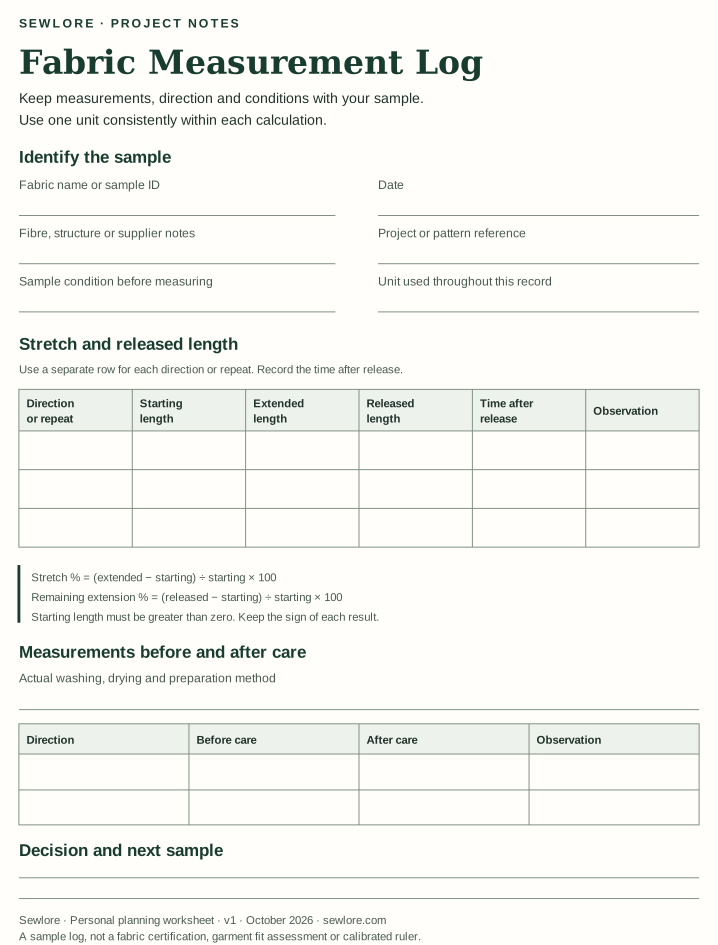
Print or fill a fabric measurement log, and import the Markdown project planner into your preferred notes app. These are blank templates for your own records.